Manufacturing Guide
Why Your Ready-Stock Knit Is Pilling — And Why Switching to a High-Cotton Blend Is the Real Fix
To fix pilling on ready-stock knits, startup buyers must choose high-cotton blends (60%+) for self-clearing fibers and demand Grade 3+ test proof—composition is your only lever when yarn and finishing
Why Your Ready-Stock Knit Is Pilling — And Why Switching to a High-Cotton Blend Is the Real Fix
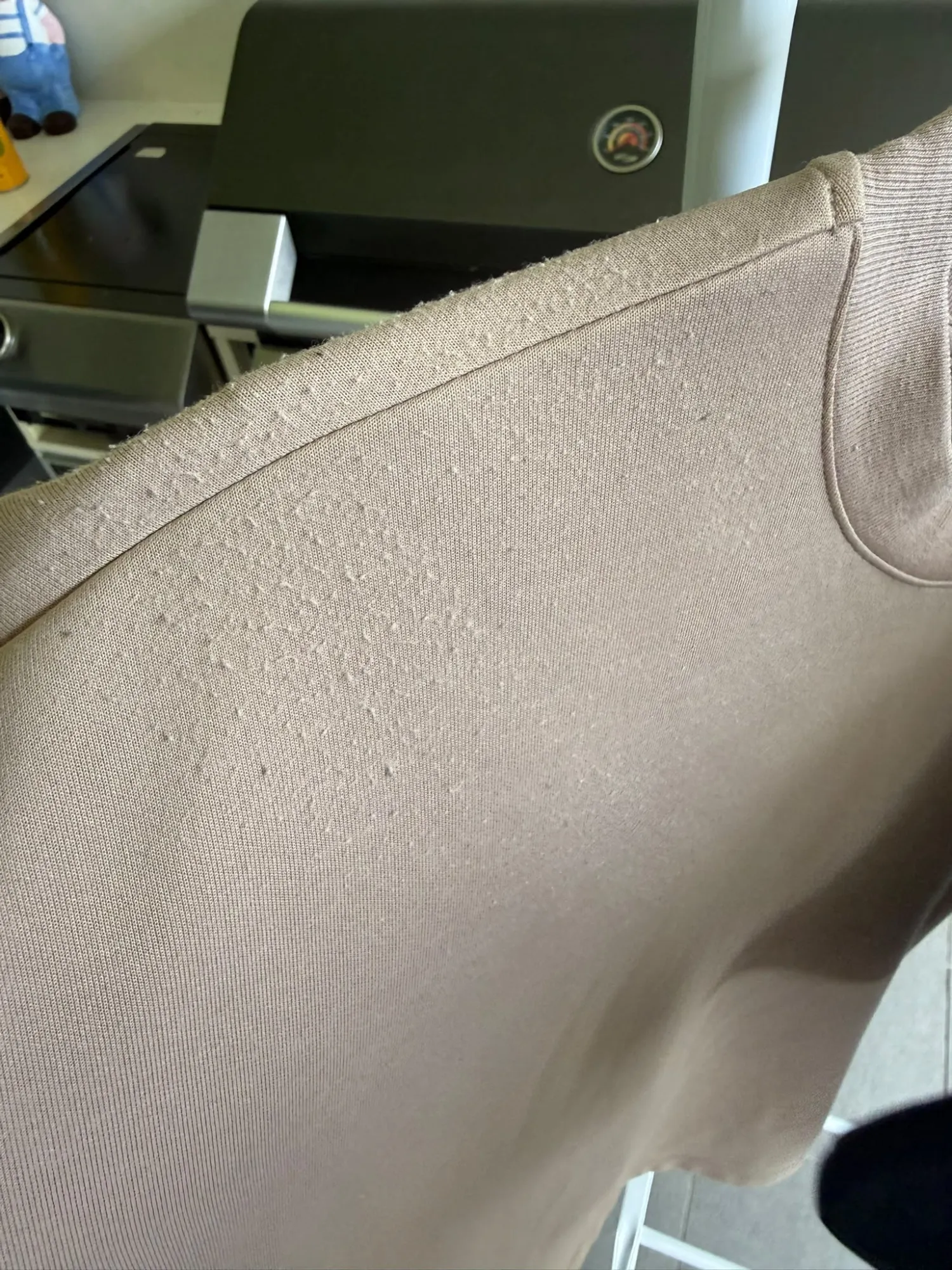
A startup buyer sent over a familiar photo this week: a 54% polyester / 41% modal / 5% spandex top, with fuzz and pills clustered on the shoulders, under the neckline, and along the diagonal seam.
Order volumes were modest, so the fabric came from the spot market — off-the-shelf rolls, ready stock, no custom knit. And that changes the whole conversation.
The Constraint Most Advice Ignores
When you buy ready-stock fabric, you inherit three things you cannot change. Yarn construction: staple length, twist, spinning method. Knit construction: gauge, stitch length, density. Finishing recipe: bio-polishing, singeing, heat setting, softeners.
You can ask the supplier. You can ask twice. But with spot goods, the finish is already done, and the recipe is almost never documented. So the usual advice — specify ring-spun yarn, raise the twist multiplier, add bio-polishing — is not available to you.
This is the reality for most startup buyer orders today. And it explains why the same pilling complaint keeps coming back.
What Is Actually Happening in That Blend
The photo tells you where to look. Shoulders and neckline are concentrated abrasion zones: bags, seat belts, hair, repeat washing. Diagonal seam lines are fabric-on-fabric internal rubbing at side seams and yokes. A modal-heavy soft hand feels premium, but it is supplying the fuzz.
During abrasion, short staple ends work loose, tangle into a ball, and the polyester fiber is too strong to break off — so the pill stays attached and grows. Pilling frequency rises as the polyester ratio rises. Add a high proportion of modal, which readily releases surface fibers, and the conditions are complete.
Component | Pilling effect |
|---|---|
54% Polyester | Anchors the pill to the surface |
41% Modal | Supplies the fuzz |
5% Spandex | Concentrates abrasion in contact zones |
The 5% spandex is not the culprit. Its role is stretch, but it does concentrate wear where the garment sits against the body.
The Genuine Fix: Move to a Higher-Cotton Blend
If you cannot control the knit and you cannot control the finish, the only lever left is fiber composition. And that is a much bigger lever than it sounds.
Cotton pills less readily than polyester because its fibers are weaker in flex. When a pill begins to form, the cotton fiber breaks off rather than holding the pill to the surface — so the surface clears itself instead of accumulating fuzz. Cotton also absorbs moisture rather than repelling it, which reduces the static and surface friction that help pills form in the first place.
The trade-off is hand feel. A high-cotton knit is less silky than modal and recovers less crisply than polyester. That is why a small percentage of spandex, or a cotton-modal-poly blend, is usually the right answer for a soft-touch top.
Blend | Pilling resistance | Best for |
|---|---|---|
60% cotton / 35% polyester / 5% spandex | High | Everyday tops, uniforms, high-wear basics |
70% cotton / 25% polyester / 5% spandex | Very high | Tees, loungewear, warm climates |
50% cotton / 37% modal / 8% polyester / 5% spandex | Moderate-high | Buyers who want to keep the modal drape |
54% polyester / 41% modal / 5% spandex (current) | Low | Avoid for high-abrasion use |
The first three are widely available as ready stock in most knitting districts. You do not need a custom mill run to access them.
What You Can Still Do With the Fabric You Have
Switching blend is the structural fix. Until then, these reduce visible damage but will not prevent it.
Wash inside out, cold, gentle cycle, no high-heat drying. Residential dryers are hot enough to trigger fiber migration in un-stabilized polyester. If you can source two qualities, cut the shoulder and side-seam panels from a firmer, tighter-knit spot cloth — even this small change moves the worst pills off the visible surface. Press with care; high heat from an iron or press can set surface fuzz and make it harder to remove. Use a fabric shaver for early fuzz; do not rub or brush aggressively.
These are damage control. They protect a fabric that was already made. They do not change how it was made.
The Question Worth Asking Your Supplier
Most spot-stock mills will tell you their fabric is anti-pilling. That claim is not useful on its own. Ask for the full composition and yarn type; the GSM and gauge, because tighter structures pill less; whether it has been bio-polished or heat set; and a pilling test result — ASTM D3512 or ISO 12945-2. For consumer-facing product, grade 3 minimum is the line we recommend. If they cannot answer, that is your answer.
Bottom Line
When order volumes are small and fabric comes off the shelf, the knit construction and the finish are fixed before you arrive. You cannot engineer the yarn. You cannot add bio-polishing after the roll is made.
So specify a higher-cotton blend at the buying stage — the single highest-leverage move available to you. Pick the firmest, densest knit you can find in the hand you want. Ask for test data, not marketing claims. And set care expectations clearly on the label, because it materially reduces complaint rates.
Startup buyer orders are the common case now, not the exception. The problem is solvable — but the solution lives in the composition column of the purchase order, not in the finishing line after the fact.
Send us the composition of the ready-stock fabric you are considering and we will tell you, from experience, which ones will pill and which will not — before you cut.